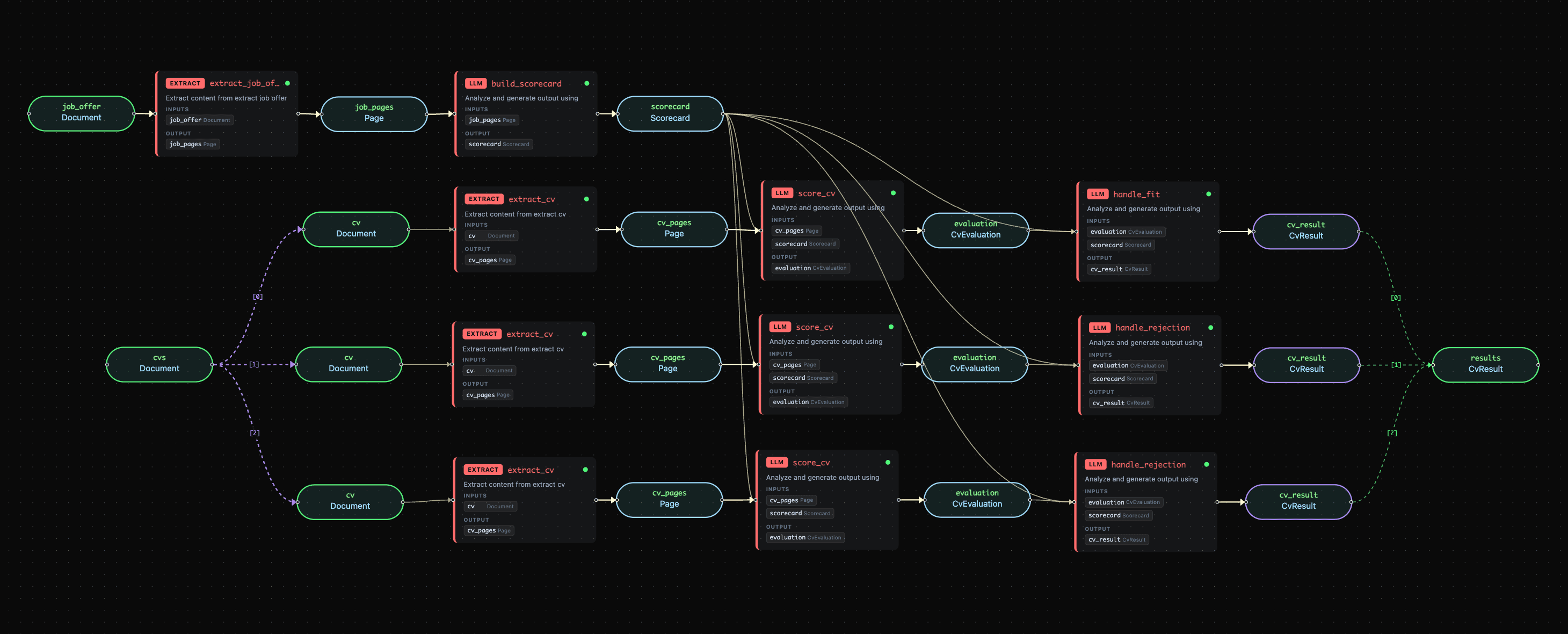
domain      = "hr_screening"
description = "Analyze a job offer to build a scorecard, batch process CVs"
main_pipe   = "screen_candidates"

# ── Concepts ──────────────────────────────────────────────

[concept.Criterion]
description = "A single evaluation criterion for scoring candidates"

[concept.Criterion.structure]
name        = { type = "text", description = "Criterion name", required = true }
description = { type = "text", description = "What this criterion evaluates", required = true }
weight      = { type = "number", description = "Importance 1-10", required = true }

[concept.Scorecard]
description = "Evaluation scorecard built from a job offer"

[concept.Scorecard.structure]
job_title       = { type = "text", description = "Job title from the offer", required = true }
company         = { type = "text", description = "Company name" }
required_skills = { type = "list", item_type = "text", description = "Skills required for the role" }
criteria        = { type = "list", item_type = "concept", item_concept_ref = "hr_screening.Criterion", description = "Evaluation criteria" }

[concept.CvEvaluation]
description = "Complete evaluation of a candidate CV"

[concept.CvEvaluation.structure]
candidate_name = { type = "text", description = "Full name of the candidate", required = true }
overall_score = { type = "number", description = "Weighted score 0-100", required = true }
fit = { type = "text", description = "Whether the candidate fits", required = true, choices = [
  "yes",
  "no",
] }
strengths = { type = "list", item_type = "text", description = "Key strengths identified" }
weaknesses = { type = "list", item_type = "text", description = "Key weaknesses identified" }

[concept.CvResult]
description = "Final screening result for a candidate"

[concept.CvResult.structure]
candidate_name = { type = "text", description = "Full name of the candidate", required = true }
overall_score = { type = "number", description = "Weighted score 0-100", required = true }
fit = { type = "text", description = "Fit assessment", required = true, choices = [
  "yes",
  "no",
] }
outcome = { type = "text", description = "Routing decision taken", required = true }

# ── Main Pipe ─────────────────────────────────────────────

[pipe.screen_candidates]
description = "Screen candidates for a job offer"
type = "PipeSequence"
inputs = { job_offer = "Document", cvs = "Document[]" }
output = "CvResult[]"
steps = [
  { pipe = "extract_job_offer", result = "job_pages" },
  { pipe = "build_scorecard", result = "scorecard" },
  { pipe = "evaluate_cv", batch_over = "cvs", batch_as = "cv", result = "results" },
]

[pipe.extract_job_offer]
description = "Extract text from the job offer document"
type        = "PipeExtract"
inputs      = { job_offer = "Document" }
output      = "Page[]"
model       = "@default-text-from-pdf"

[pipe.build_scorecard]
description = "Build a scorecard from a job offer"
type = "PipeLLM"
inputs = { job_pages = "Page[]" }
output = "Scorecard"
model = "$writing-factual"
prompt = """Analyze this job offer and build a scorecard with weighted criteria.

@job_pages
"""

[pipe.evaluate_cv]
description = "Evaluate a candidate CV"
type = "PipeSequence"
inputs = { cv = "Document", scorecard = "Scorecard" }
output = "CvResult"
steps = [
  { pipe = "extract_cv", result = "cv_pages" },
  { pipe = "score_cv", result = "evaluation" },
  { pipe = "route_by_fit", result = "cv_result" },
]

[pipe.extract_cv]
description = "Extract text from a candidate CV"
type        = "PipeExtract"
inputs      = { cv = "Document" }
output      = "Page[]"
model       = "@default-text-from-pdf"

[pipe.score_cv]
description = "Score a candidate CV"
type = "PipeLLM"
inputs = { cv_pages = "Page[]", scorecard = "Scorecard" }
output = "CvEvaluation"
prompt = """Score the candidate on EACH criterion from the scorecard.

@cv_pages

@scorecard
"""

# ── Conditional Routing ───────────────────────────────────

[pipe.route_by_fit]
description     = "Route a candidate CV by fit"
type            = "PipeCondition"
inputs          = { evaluation = "CvEvaluation", scorecard = "Scorecard" }
output          = "CvResult"
expression      = "evaluation.fit"
default_outcome = "handle_rejection"

[pipe.route_by_fit.outcomes]
yes = "handle_fit"
no  = "handle_rejection"

[pipe.handle_fit]
description = "Build result for a candidate who fits the role"
type = "PipeLLM"
inputs = { evaluation = "CvEvaluation", scorecard = "Scorecard" }
output = "CvResult"
prompt = """Build a positive screening result for this candidate.

@evaluation

@scorecard
"""

[pipe.handle_rejection]
description = "Build result for a candidate who does not fit"
type = "PipeLLM"
inputs = { evaluation = "CvEvaluation", scorecard = "Scorecard" }
output = "CvResult"
prompt = """Build a rejection screening result for this candidate.

@evaluation

@scorecard
"""